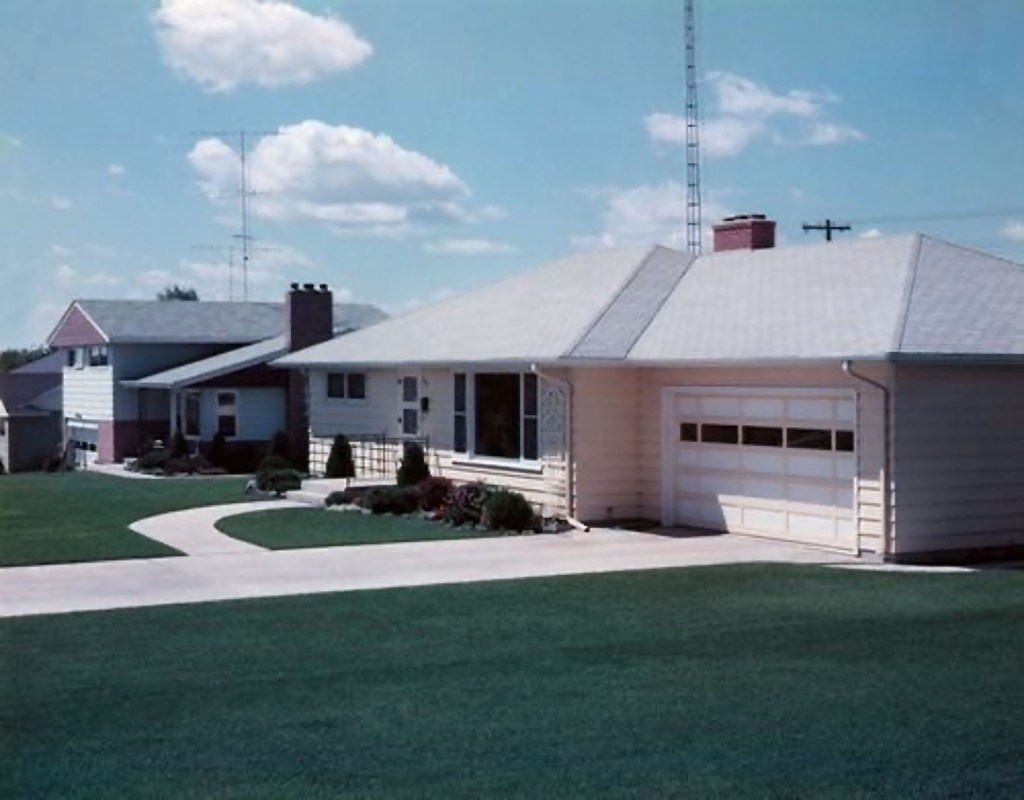
The simple act of being a 10k-step girly radicalized me. Bear with me. When I started going on daily walks a couple of years ago, mostly for health benefits, I never expected it to completely upend the way I view the systems we have in place. During my hour-and-a-half long walks, it was common for me not to encounter a single person to say hello to. I would consider myself lucky if I came across two people to greet. Instead of hearing people, I could only hear the sound of cars driving past me, and you can’t exactly interact with that. It evoked feelings of uneasiness. This essay will not center on the historical and political context of American suburbs. Rather, it will serve as a reflection of one person’s experience living in the suburbs, how I realized their association with loneliness, and our greatest loss within suburbia: connection.
We’ve all heard it before: humans are social creatures. It’s an essential component of our biology and thus, our survival. Positive social interactions keep us happy. When I walk this distance and see so few people outside, it leaves me craving more. I want to see faces and spontaneously encounter strangers. When these possibilities vanish, something feels wrong inside me. These experiences led to some critical questions: Were humans meant to live like this? Were the streets intended to be this underutilized and quiet most of the time? Where is everybody?
First, it’s crucial to provide a brief background of American suburbs. Single-use zoning requires commercial, residential, and industrial buildings to be separated from one another. It has been the prevailing form of land use regulation in the U.S. This restricts residential areas, such as single-family homes and apartment buildings, from being broken up by places like grocery stores, shops, restaurants, schools, banks, etc. Places and services that people regularly need access to were placed just beyond feasible walking distance, all but guaranteeing the purchase of a vehicle for every adult. I speculate that connection and accessibility were never the primary considerations when suburbs were designed; consumption was. This blueprint is conducive to social isolation, which helps explain why the streets are consistently devoid of people during my walks.
The differences become even more striking each time I visit a major city. I can’t help but be in awe at how different life can look depending on where you live. The built-in environment in cities encourages connection. Tenants in the same apartment building often know each other well and frequently lend a hand to one another. You take a couple of steps outside your home and find food, coffee, shops, and plenty more. Corner stores are situated in the heart of neighborhoods, ready when you’re in a pinch. In my parents’ home country of Mexico, every community and neighborhood, both urban and rural, is equipped with a tiendita or “little shop.” Even they saw the need for and benefit of it. For lack of a better term, I’m mind-blown at the fact we were afforded exactly none of this in the suburbs, and I envy the convenience. The contrast is stark, and it raises questions about the possibilities for our communities.
Further, I’ve noted the rise of home surveillance systems over the last decade or so, and how this can also sever connection. It seems virtually every house is monitored by a camera system, or at least is the case in my neighborhood. In theory, the cameras are for safety purposes. In practice, with a large emphasis on family and property in the suburbs, home surveillance systems send out the silent message: keep out and don’t try anything. When I walk past certain houses, some of their cameras have a motion-activated feature that says, “You are being recorded right now.” Signs in windows that say, “Smile, you’re on camera.” I don’t suspect crime deterrent to be the priority; it’s about exclusion and boundaries. The neighborhood watch reports anyone suspicious, but I view it as quiet judgment of anyone who seems any bit different and therefore, untrustworthy. Fear and surveillance cosplaying as caring for your community. I wonder how many people’s cameras I showed up on during my walk. A thousand? The thought makes me shudder.
Suburbanites often fail to discern what is required of real community: vulnerability, trust, and shared spaces. It’s reliant on people being open to getting to know someone who may not conform in lifestyle or appearance. They are robbing themselves of a chance to learn something from them by being reflexively distrustful. Admittedly, simply waving hello to someone does not suffice for me. True community is built by forming rapport with our neighbors. It’s about establishing relationships, understanding one another, and creating a sense of belonging. It’s a goal worth aiming for, and it can make a palpable difference in the way we live.
I’m not telling you to move to the downtown of a major city. Indeed, there are people who thoroughly enjoy their lives in the suburbs and prefer this model, and that’s acceptable. I cannot force somebody to be upset about a system they have no issue with for themselves. I am not here to convince you that your surroundings are making you miserable. I’m asking for options we were not given. I’m requesting for those of us with different preferences to be accommodated, just as suburbanites were. It’s not an either/or situation. We can design suburbs in a way that offers convenience and opportunities for connection while maintaining the tranquility that attracted many to them in the first place. People can still have space and perceived safety without being isolated.
I walk all this distance, wanting to see society and wanting to be seen, but such a privilege is not granted in the suburbs. I had been lonely for a long time without realizing it. I was unaware of how systematic this social deprivation was. If there’s one sentence that can convey my feelings, it would be: I’m overwhelmed by a desire to connect but underwhelmed with the options I have. We must be willing to envision other ways of life after recognizing how much the setting we’re in affects our well-being. We can update our zoning laws, enter a new era of urban planning, and redesign our cities. Even if it doesn’t happen in my lifetime, it’s worth shedding light on the problem and acknowledging we deserve better.
 Emily Writes
Leave a comment